
CETPartnership Joint Call 2024 · CETP-2024-00202
Cost-effective green hydrogen using AC:DC operated durable SOECs
CHARGE develops durable, low-cost solid oxide electrolysis stacks — impurity-tolerant cells, protected interconnects and AC:DC operation — to bring green hydrogen below 5 €/kg.
- < 5 €/kgtarget levelised cost of hydrogen
- 6partners from DK, DE and PL
- 36 monthsDec 2025 – Nov 2028
- TRL 5at the end of the project





Latest news
- A durability record from CHARGE partners: 25,000 hours of solid oxide electrolysis in Nature Communications
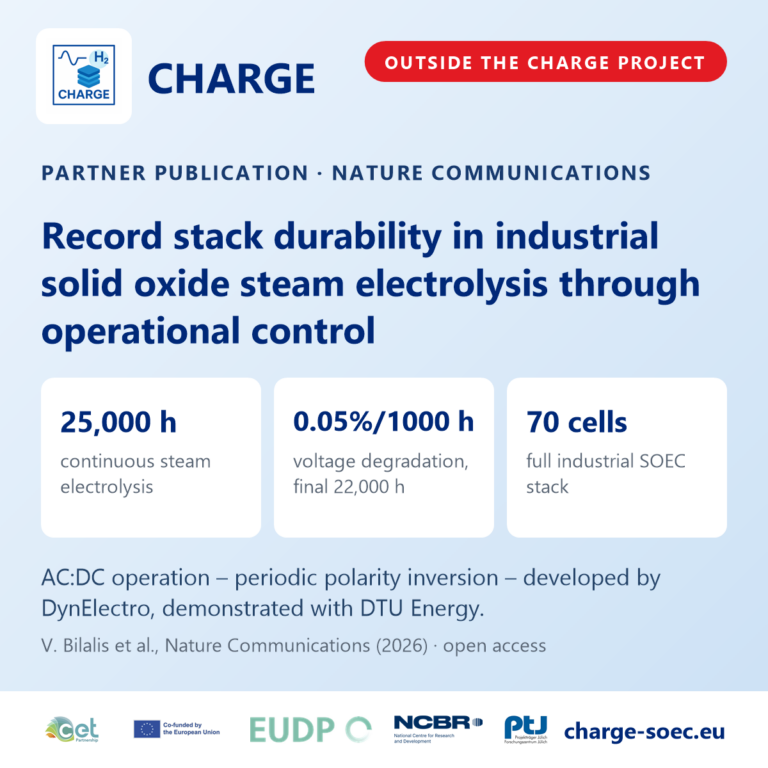 Two CHARGE partners — DTU Energy and DynElectro — have published in Nature Communications the longest… Read more: A durability record from CHARGE partners: 25,000 hours of solid oxide electrolysis in Nature Communications
- Kacper Caputa — PhD student at COAT-IT in the CHARGE project
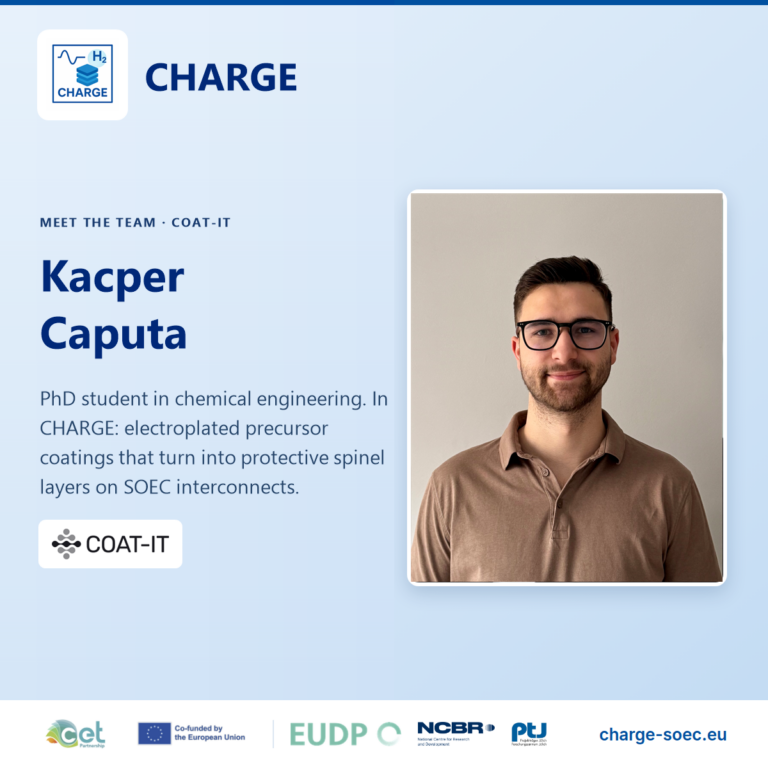 Meet Kacper Caputa, a PhD student in chemical engineering at COAT-IT — the Polish SME responsible… Read more: Kacper Caputa — PhD student at COAT-IT in the CHARGE project
- First CHARGE publication: nano-scale evidence of impurity poisoning in SOECs
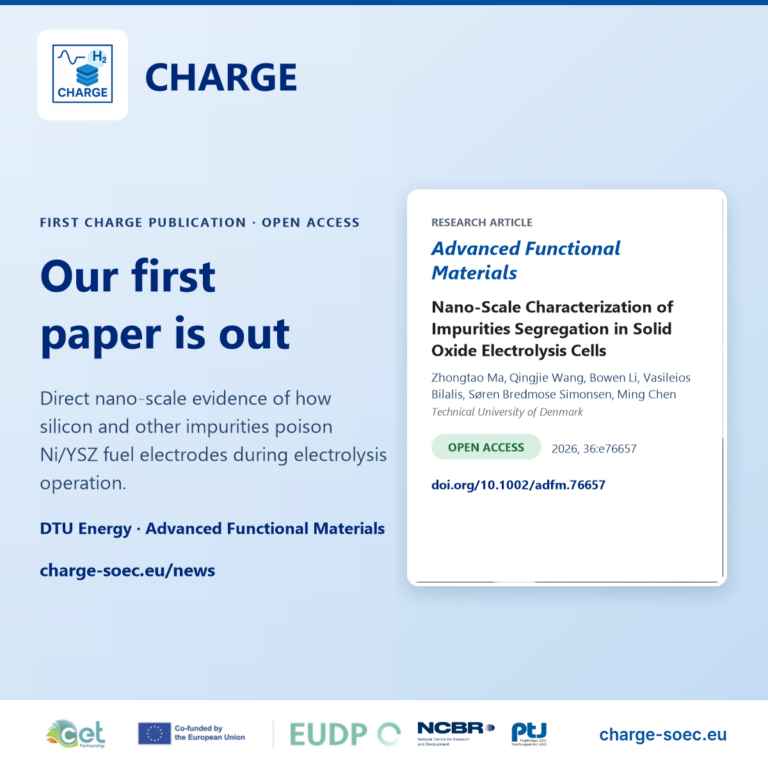 The first peer-reviewed paper acknowledging CHARGE, in Advanced Functional Materials: direct nanoscale evidence of how impurities poison Ni/YSZ electrodes under electrolysis operation. Open access.
The CHARGE project develops next-generation solid oxide electrolysis cell (SOEC) stack technology for efficient and durable green hydrogen production. By combining impurity-tolerant cells, low-cost coated interconnects, and a novel AC:DC operation strategy, CHARGE aims to reduce the levelized cost of hydrogen to below 5 €/kg — a 30% reduction compared to current state-of-the-art SOEC systems.
CHARGE brings together six partners from Denmark, Germany, and Poland, covering the full chain from fundamental materials research to industrial stack manufacturing. The project is funded through the CETPartnership Joint Call 2024 with support from national funding agencies EUDP (Denmark), PtJ (Germany), and NCBR (Poland).