
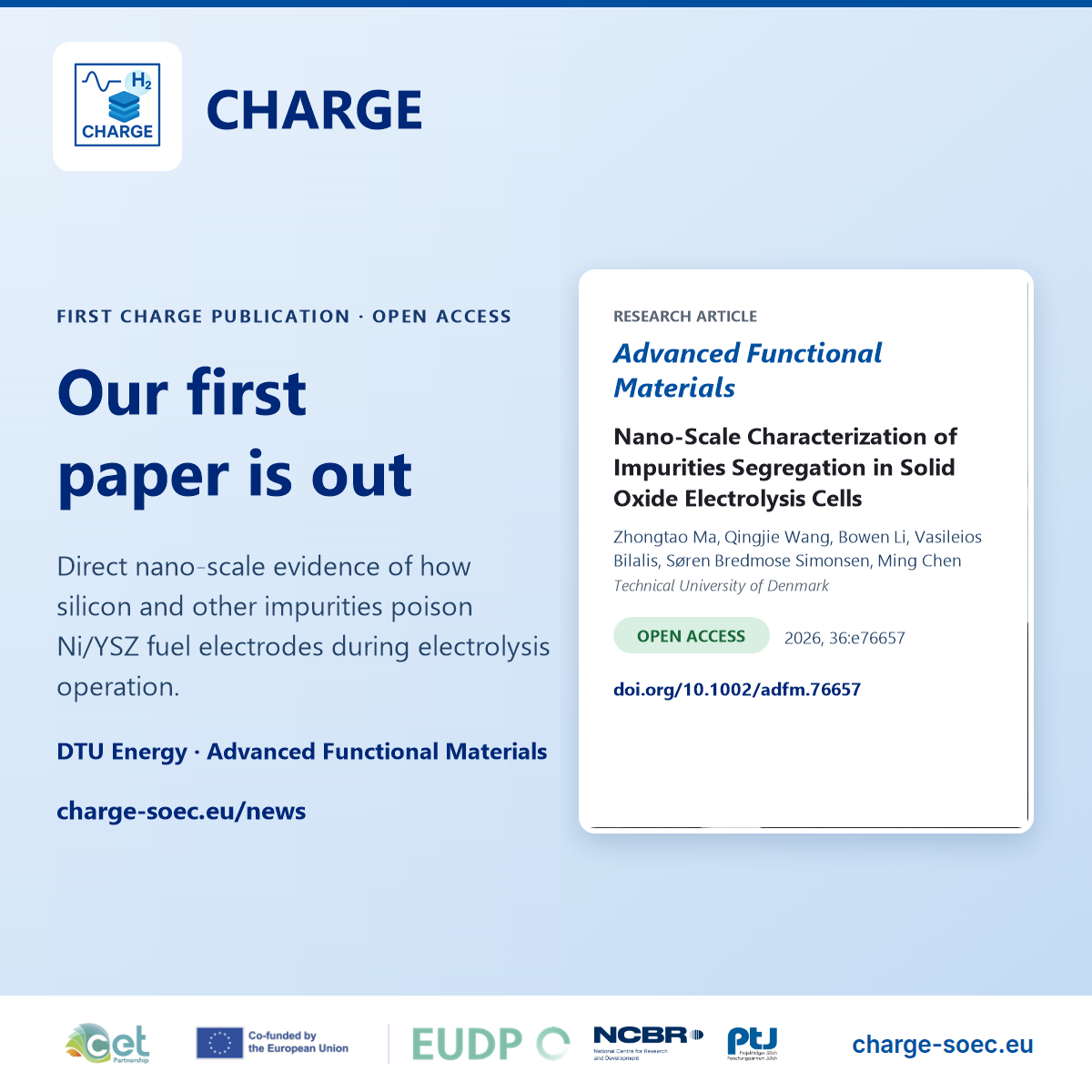
The first peer-reviewed publication acknowledging CHARGE is out — in Advanced Functional Materials, one of the leading journals in materials science:
“Nano-Scale Characterization of Impurities Segregation in Solid Oxide Electrolysis Cells”
Zhongtao Ma, Qingjie Wang, Bowen Li, Vasileios Bilalis, Søren Bredmose Simonsen, Ming Chen
Advanced Functional Materials 2026, 36:e76657 — read the full text (open access) · doi.org/10.1002/adfm.76657
What the paper shows
Impurities such as silicon are one of the main reasons why Ni/YSZ fuel electrodes degrade faster in electrolysis than in fuel-cell operation. Using a model Pt–SiO₂–Ni/YSZ/Pt cell and post-mortem STEM-EDS and HRTEM analysis, the team compared identical electrodes after cathodic (electrolysis) and anodic (fuel-cell) polarization. The results provide the first direct nanoscale evidence that, under electrolysis conditions, Na–Al–Si–O segregates as an amorphous phase along nickel grain boundaries, while zirconium and yttrium are extracted from the YSZ electrolyte and re-precipitate near the Ni/YSZ interface. The driving force is the extremely low oxygen partial pressure generated by cathodic polarization, which allows these elements to dissolve into metallic nickel, migrate, and re-oxidize where oxygen activity is higher. In the fuel-cell reference, exposed to the same temperature history, these effects are largely absent.
Why it matters for CHARGE
This polarization-driven impurity transport is precisely the mechanism that the impurity-tolerant cells developed in Work Package 2 must withstand at high current density. Direct nanoscale evidence of how it operates gives the consortium a concrete target for mitigation — from cell design to the purity requirements for interconnects and balance-of-plant components studied in Work Package 3.
The work was led by the Technical University of Denmark (DTU Energy) and was supported by the Independent Research Fund Denmark, with Ming Chen acknowledging funding from the CHARGE project (CETP-2024-00202; EUDP project no. 640256-550283). The article is open access (CC BY).
CHARGE (CETP-2024-00202) is funded through the CETPartnership Joint Call 2024, with support from EUDP (Denmark), NCBR (Poland) and PtJ on behalf of BMWE (Germany).