
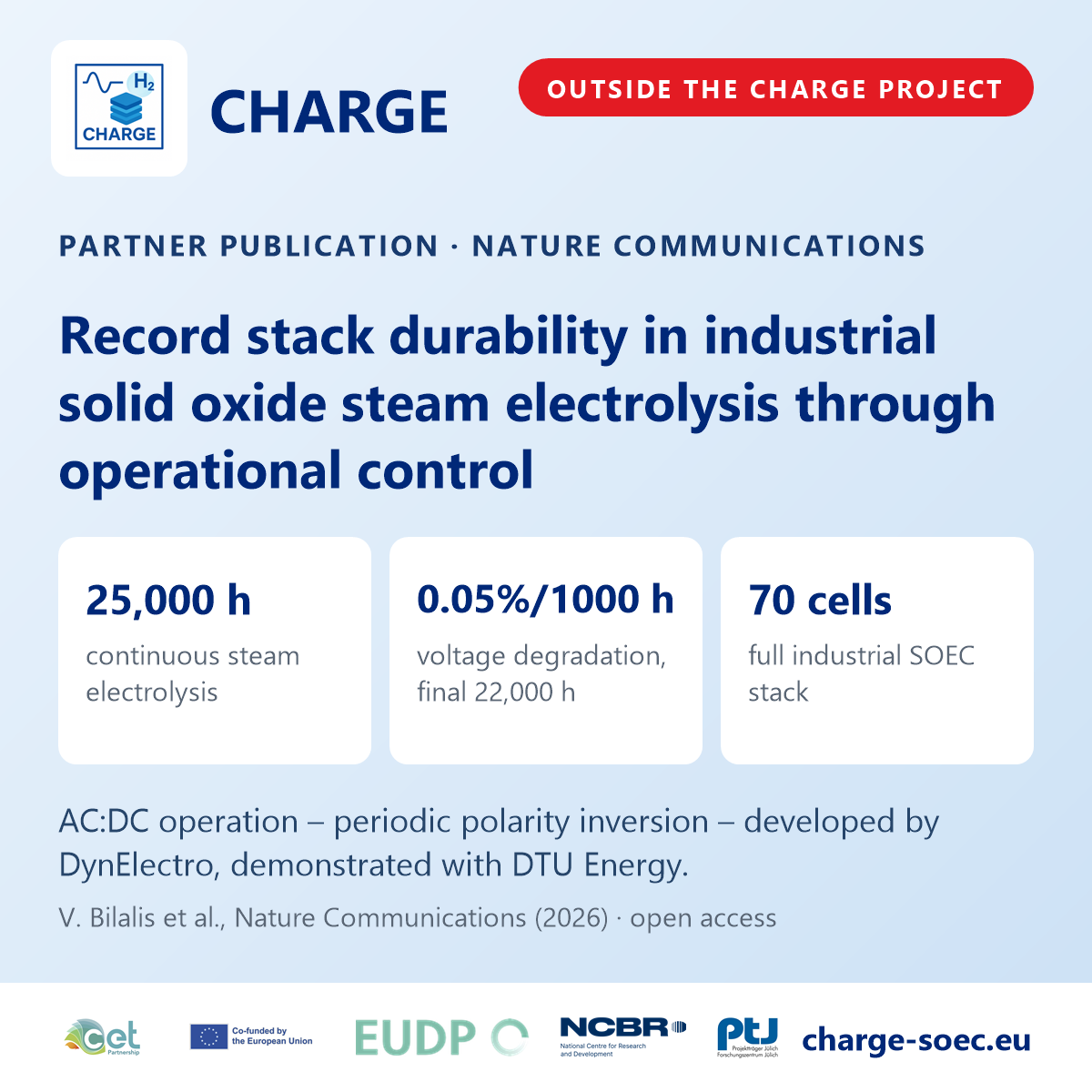
Two CHARGE partners — DTU Energy and DynElectro — have published in Nature Communications the longest and lowest-degradation operation reported to date for a full solid oxide electrolysis stack.
An industrial 70-cell stack ran for 25,000 hours of steam electrolysis under AC:DC operation — the frequency-dependent operating strategy developed by DynElectro, in which the stack periodically inverts polarity between electrolysis and fuel-cell mode. After an initial conditioning phase, the stack entered a stabilized regime with an average voltage degradation rate of 0.05% per 1000 hours (0.65 mV per 1000 hours per cell), sustained over the final 22,000 hours of the test. For comparison, the same stack degraded at 11.5% per 1000 hours during its initial period of conventional DC operation.
Post-test microstructural analysis supports the electrochemical data: the degradation pathways commonly observed after long-term DC electrolysis — nickel migration, impurity accumulation and detachment at the electrode interface — were not measurably activated under AC:DC operation.
The study was carried out independently of CHARGE, but it demonstrates the central idea our project builds on: stack durability is determined by operational strategy as much as by materials. In CHARGE, AC:DC operation is combined with impurity-tolerant cells and coated steel interconnects, and validated on industrial stack platforms.
Among the authors are CHARGE coordinator Marie Lund Traulsen and Ming Chen. Congratulations!
The article is available open access: V. Bilalis et al., Record stack durability in industrial solid oxide steam electrolysis through operational control, Nature Communications (2026). https://doi.org/10.1038/s41467-026-78001-1