
Motivation
Green hydrogen produced by water electrolysis is central to the clean energy transition. Among electrolysis technologies, solid oxide electrolysis cells (SOECs) offer approximately 20% higher power-to-hydrogen efficiency than alkaline (AEC) or proton exchange membrane (PEMEC) systems and avoid critical raw materials like platinum and iridium. However, SOEC commercialization is limited by insufficient lifetime (currently 2–3 years), high stack costs, and sensitivity to impurities and dynamic operation.
Our Approach
The CHARGE project tackles these barriers through four specific objectives:
- Impurity-tolerant SOEC cells (SpO1) — We develop electrodes and cells that withstand contaminants such as Si and Cr during high-current operation (1–1.5 A/cm²), targeting degradation rates below 0.3%/kh.
- Cost-effective coated interconnects (SpO2) — We replace expensive Crofer22APU alloys with generic 430-grade stainless steel and a non-CRM protective coating (Mn₁.₅Fe₀.₅CuO₄) applied by electroplating, targeting 70% cost reduction while maintaining ASR ≤ 20 mΩ·cm².
- AC:DC operation for durability (SpO3) — By superimposing alternating current on the DC electrolysis signal, we aim to reverse degradation mechanisms in situ and achieve voltage degradation below 0.3%/kh on industrial stacks.
- Advanced durable SOEC stacks (SpO4) — Integrating the improved cells, interconnects, and AC:DC strategy into optimized stack designs, we target stable operation at 1–1.5 A/cm² with degradation below 0.5%/kh.
Target Impact
These developments converge on a single strategic goal: reducing the levelized cost of hydrogen (LCOH) by at least 30% compared to state-of-the-art, achieving below 5 €/kg. The SOEC stack technology will reach TRL 5 by the end of the 36-month project.
Project Structure
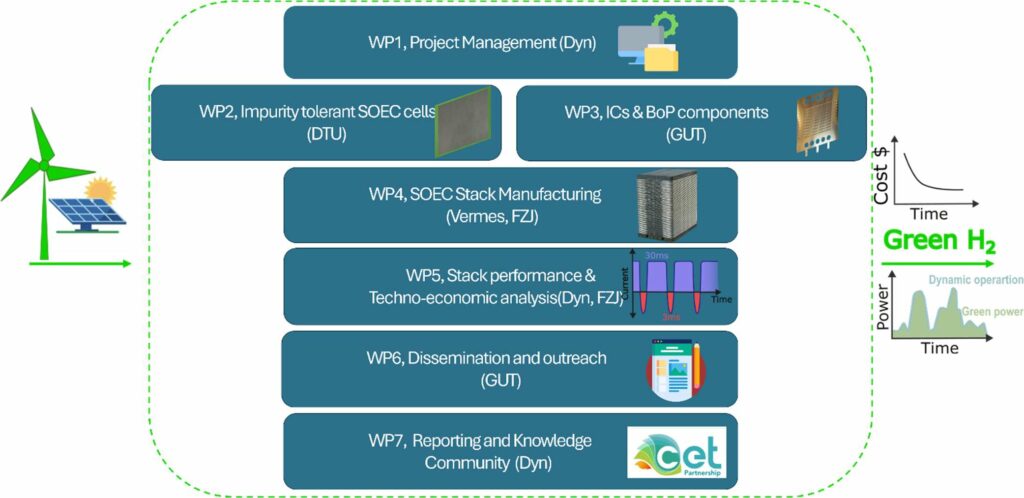
CHARGE is organized into seven work packages spanning cell development, interconnect optimization, stack manufacturing, performance testing, techno-economic analysis, and dissemination. The project runs from 2026 to 2028, coordinated by DynElectro (Denmark), with partners DTU (Denmark), FZJ (Germany), Gdańsk Tech (Poland), COAT-IT (Poland), and VERMES (Germany).