Consortium
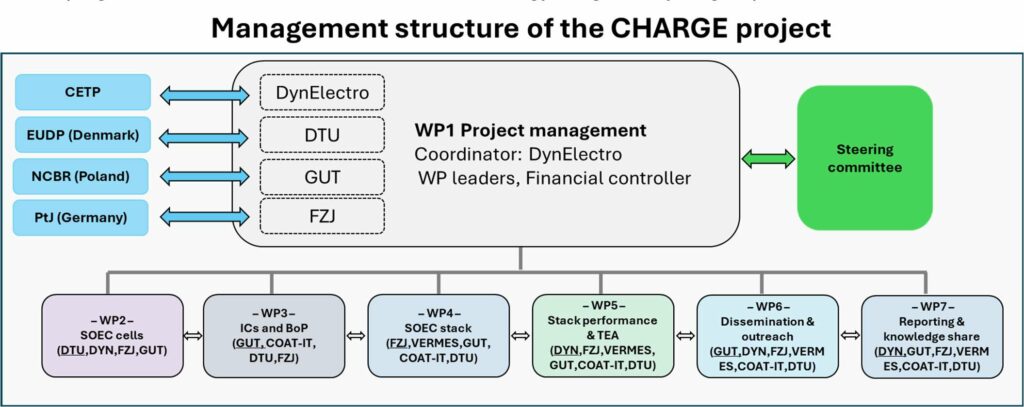
CHARGE brings together six partners from three countries, covering the entire value chain from fundamental materials research to industrial stack manufacturing. The consortium combines three academic institutions with three industrial partners, forming an early-stage commercial supply chain where project results feed directly into product development.
DynElectro ApS — Denmark (Coordinator) Industry · WP1, WP5, WP7 lead
DynElectro specializes in AC:DC operation technology for solid oxide cells. With participation in over 30 national and international research projects since its founding, DynElectro coordinates the CHARGE project and leads performance testing of industrial SOEC stacks and techno-economic analysis. As a potential end-user of high-performance stacks, DynElectro provides a direct path from project results to commercial deployment.
Technical University of Denmark, Department of Energy Conversion and Storage (DTU) — Denmark Academic · WP2 lead
DTU Energy has over 20 years of experience in solid oxide cell development and scale-up. Equipped with state-of-the-art facilities for cell manufacturing, testing, and characterization, DTU develops impurity-tolerant SOEC cells optimized for high-current operation and supplies them for stack assembly and partner testing.
Gdańsk University of Technology, Department of Functional Materials Engineering (Gdańsk Tech) — Poland Academic · WP3, WP6 lead
GUT specializes in corrosion experiments, coating development (electrophoretic, electrolytic, spray-pyrolysis), and performance evaluation of high-temperature materials. In CHARGE, GUT conducts corrosion testing of coated and uncoated stainless steels, evaluates BoP component impurity emissions, leads the interconnect work package, and manages project dissemination and the project website.
Forschungszentrum Jülich GmbH (FZJ) — Germany Academic · WP4 lead
FZJ has over 30 years of experience in solid oxide technology, covering the entire chain from powder to system level. In CHARGE, FZJ leads stack manufacturing using its established F10 short-stack platform, integrating optimized cells from DTU and coated interconnects from GUT/COAT-IT. FZJ also performs post-test analysis and stack disassembly to feed back into materials development.
VERMES Microdispensing GmbH / VERMES SOC Technology — Germany Industry
VERMES SOC Technology provides industrial-sized SOEC stacks based on technology originating from Ceramic Fuel Cell Limited (Australia), proven through extensive fuel cell testing in European projects. In CHARGE, VERMES supplies state-of-the-art 5 kW SOEC stacks for AC:DC testing at DynElectro and interconnects for coating development.
COAT-IT develops advanced surface protection technologies based on nanotechnology. In CHARGE, COAT-IT develops and scales a proprietary electroplating process for depositing Mn₁.₅Fe₀.₅CuO₄ protective coatings on full-scale interconnects, targeting a pilot production line capable of coating >20 ICs per hour. This provides a cost-effective and CRM-free alternative to conventional coating methods.