
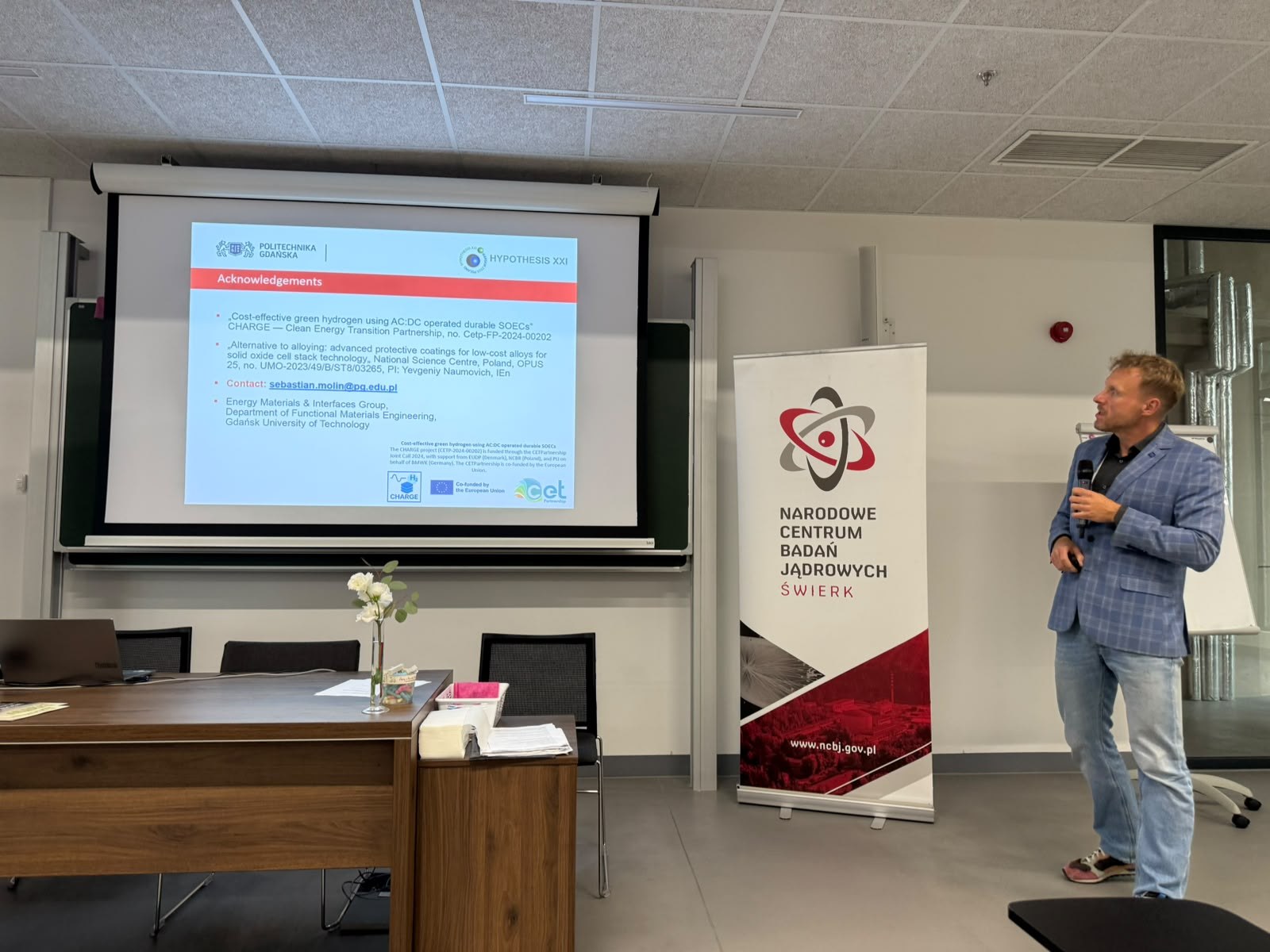
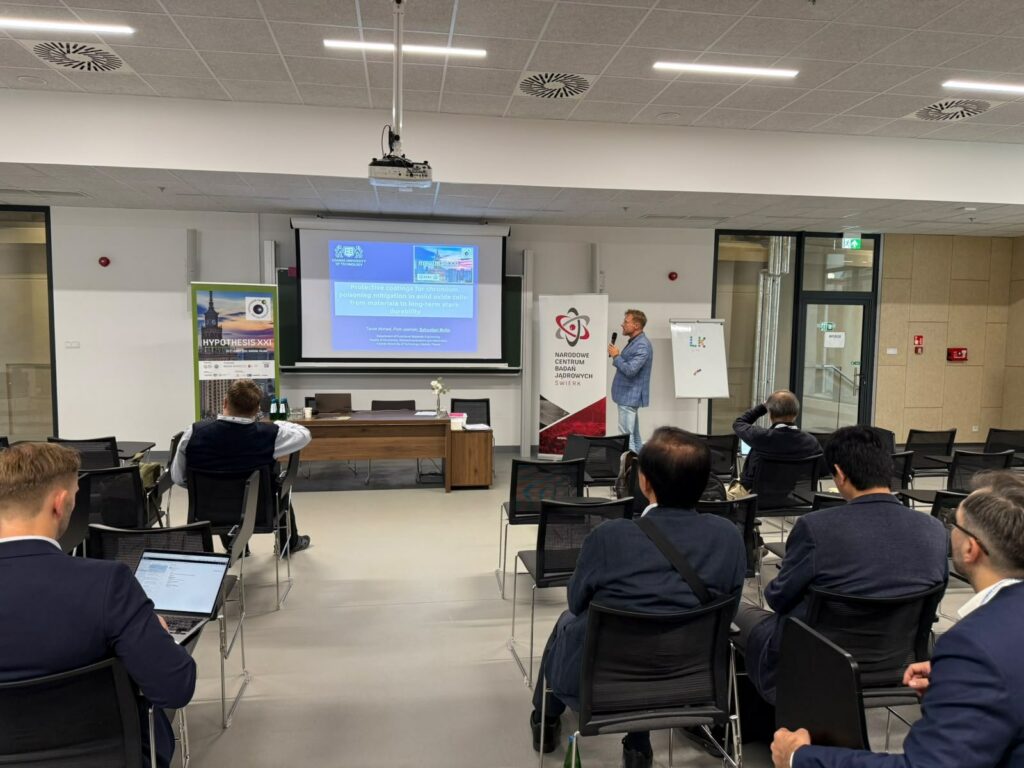
CHARGE results were presented at HYPOTHESIS XXI — the 21st Hydrogen Power Theoretical and Engineering Solutions International Symposium — held in Warsaw on 23–27 August 2026, organised by the National Centre for Nuclear Research (NCBJ) with Warsaw University of Technology. Sebastian Molin gave the talk on 24 August in the Electrolysis and Fuel Cells session.
Protective coatings for chromium poisoning mitigation in solid oxide cells: from materials to long-term stack durability
T. Ahmed, P. Jasiński, S. Molin — Department of Functional Materials Engineering, Faculty of Electronics, Telecommunications and Informatics, Gdańsk University of Technology
The problem
Chromia-forming stainless steels cannot be avoided in a solid oxide stack. They are what the interconnects and much of the balance of plant are made from — and they are one of the leading sources of degradation. Volatile chromium species evaporate from the steel and deposit at the air electrode, where they progressively destroy its performance. Any stack meant to run for tens of thousands of hours has to deal with this.
What a coating has to do
Protective coatings on the metallic interconnects are the main mitigation route, and the requirements pull against one another: a coating must suppress chromium volatilisation, stay electrically conductive, remain thermomechanically and chemically stable, and be deposited by a process cheap and robust enough for production — all at once, under dynamic operation. Performance turns out to be governed strongly by microstructure, which is why the field is moving towards optimised spinel chemistries, chromium-tolerant electrodes, and better accelerated-testing methods.
What Gdańsk Tech brings
The talk covered both halves of the problem as the group works on it: developing and evaluating spinel-type protective coatings, including those made by the group’s spray-pyrolysis route, and a measurement platform that quantifies chromium poisoning under realistic conditions — single-cell testing combined with chronopotentiometry, electrochemical impedance spectroscopy and distribution-of-relaxation-times analysis. That combination links a coating recipe directly to stack- and system-level durability, and it extends to the other impurity-driven degradation mechanisms CHARGE is chasing in work package 3.
The work presented was supported by CHARGE and by the AltCoat project (National Science Centre, Poland, OPUS 25, no. UMO-2023/49/B/ST8/03265).
CHARGE (CETP-2024-00202) is funded through the CETPartnership Joint Call 2024, with support from EUDP (Denmark), NCBR (Poland) and PtJ on behalf of BMWE (Germany).