
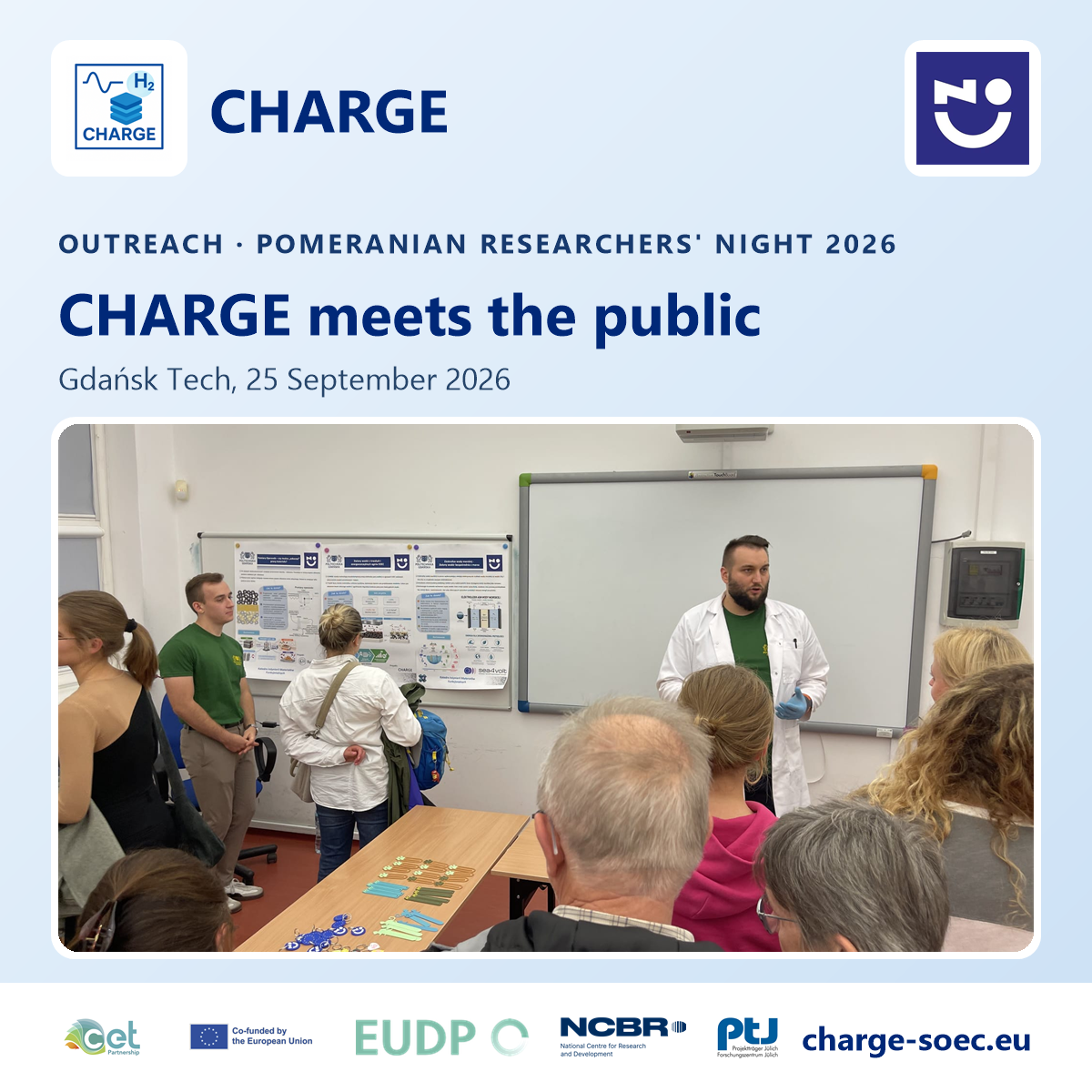
On 25 September 2026, Gdańsk University of Technology took part in the Pomeranian Researchers’ Night — the regional edition of the European Researchers’ Night, a Europe-wide public outreach event funded under the Marie Skłodowska-Curie Actions.
The Department of Functional Materials Engineering ran a public stand, Green hydrogen production — methods and challenges for electrolysers and fuel cells, from 18:00 to 21:00 in the Nanotechnology A building. The stand was hosted by PhD researcher Bartłomiej Lemieszek together with students Adam Zasiński and Bartłomiej Tokarski. Entry was free and open to everyone — children, teenagers and adults.
Visitors learned why “green” hydrogen matters, whether seawater can be used directly for hydrogen production, and what the main durability challenges of electrolysers are: corrosion, electrode degradation and contamination. CHARGE was presented with a short Polish-language poster, Green hydrogen from durable and energy-efficient SOEC cells, explaining how impurity-tolerant cells, protective interconnect coatings and AC:DC operation together lead to longer-lived stacks and cheaper hydrogen. Two other hydrogen projects of the group, Sea4Volt and SynOpEIS, were presented alongside.
Public events like this are part of the CHARGE communication plan: explaining to a non-specialist audience why stack durability — not just efficiency — decides the cost of green hydrogen.
CHARGE (CETP-2024-00202) is funded through the CETPartnership Joint Call 2024, with support from EUDP (Denmark), NCBR (Poland) and PtJ on behalf of BMWE (Germany).